

Check the EcoFlow WAVE 3 price on Amazon
Quick verdict
This EcoFlow WAVE 3 review finds it one of the more credible portable air conditioners for campervans and tents because it combines genuine compressor cooling with heating, dehumidification, app control and several power options. Its published 6,100 BTU cooling output should be meaningful in a compact vehicle cabin, particularly when the van is shaded and insulated.
It is not a tiny fan, though. The unit weighs about 15.6 kg before the optional battery, needs a properly sealed route for its warm exhaust air and draws roughly 690W when cooling from AC power. For a VW California, campsite electric hook-up is the simplest setup. Battery operation is possible, but the headline eight-hour figure is an Eco Mode maximum under favourable conditions rather than a promise of full-power cooling all night.
What is the EcoFlow WAVE 3?
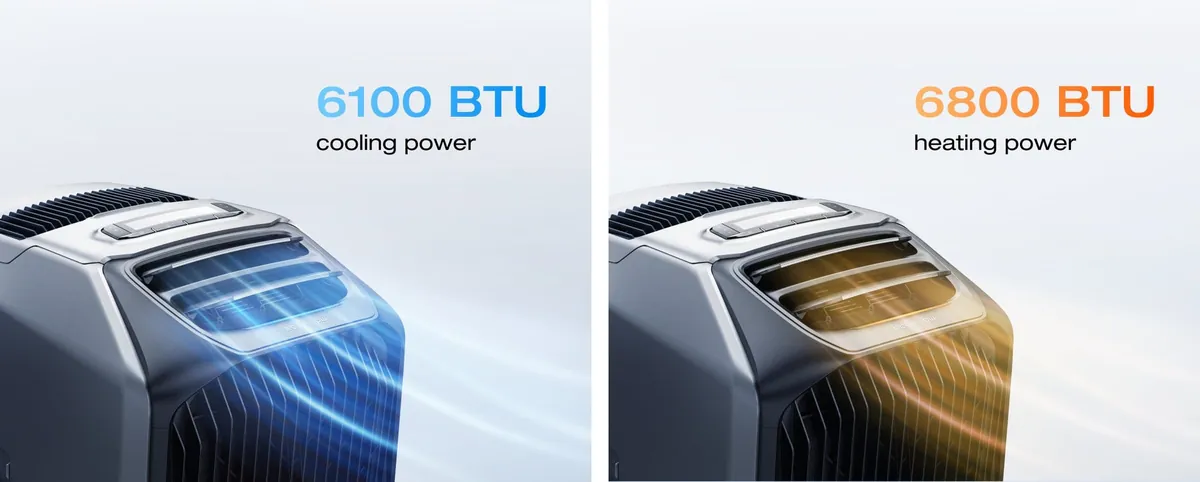
For this EcoFlow WAVE 3 review, the key point is that the WAVE 3 is a portable heat-pump air conditioner designed for small spaces including campervans, motorhomes and tents. EcoFlow rates it at 1,800W (6,100 BTU) of cooling and 2,000W (6,800 BTU) of heating, with a temperature range of 16-30°C. It also offers dehumidification, automatic heating and cooling, Sleep Mode and control through the EcoFlow app over Wi-Fi or Bluetooth.
| Specification | Published figure |
|---|---|
| Cooling capacity | 1,800W / 6,100 BTU |
| Heating capacity | 2,000W / 6,800 BTU |
| Dimensions | 519 × 297 × 336 mm |
| Unit weight | About 15.6 kg |
| Rated cooling input | 690W AC / 640W DC |
| Noise range | 44-58 dB |
| Air volume | 330 m³/h |
| Water resistance | IPX4 |
| Optional battery | 1,024Wh LFP, sold separately |
Why it interests me as a VW T6 California owner
A useful EcoFlow WAVE 3 review has to account for the vehicle around it. Our long-term VW California experience has taught me that comfort is always a balance between space, weight, power and ventilation. The California is compact enough for an air conditioner of this output to make a noticeable difference, yet it is also full of fixed furniture, moving seats and essential walkways. Any cooling solution has to earn the space it occupies.
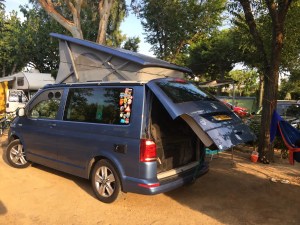
The biggest limitation is not nominal cooling power; it is getting the hot exhaust air outside without allowing the same heat straight back in. The California’s large windscreen, side glass and fabric pop-top absorb heat quickly. External windscreen covers, shaded parking, closed blinds and cooling one occupied zone will all reduce the workload.
How could the WAVE 3 fit in a VW California?
At 519 × 297 × 336 mm, the WAVE 3 is substantial but still compact enough for several possible layouts. It could sit on a protected floor area near the sliding door, on the rear storage shelf while stationary, or in an awning with cooled air ducted into the van. Whatever the position, it must remain level, have clear airflow and never block a door, seat mechanism or emergency exit.
A front or side-window ventilation panel offers a logical duct route. A removable vent would need correctly sized openings for the supplied ducting, weather sealing and enough rigidity to prevent warm outside air leaking back into the cabin. The good news is that there are now 3D printed vents available on Ebay for the passenger window and the side windows. Measure the WAVE 3, duct diameters, window panel and intended storage position before buying; the exact fit will depend on the van model and vent design.
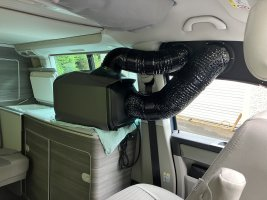
This example is useful because it shows the reality of the installation: the unit occupies genuine furniture space and the ducting needs careful routing. It is evidence of a workable concept, not a guarantee that the same arrangement fits every T5, T6, T6.1 or accessory layout. We tried this and also sitting the unit in front of the cupboards on the floor. There is space when the downstairs bed is down.
Power options in a campervan
Campsite electric hook-up
For most California owners, electric hook-up is the most straightforward answer. That is the baseline power option used in this EcoFlow WAVE 3 review. The WAVE 3’s rated AC cooling input is about 690W, comfortably below a typical UK campsite hook-up limit, although you still need to consider the combined load from a kettle, induction hob, charger or heater. Do not assume every European pitch supplies the same amperage. Unlike the UK where 16A is standard, French campsites commonly offer 6A (approx. 1,380W) or 10A (approx. 2,300W). Some budget or rural sites may even limit you to 3A to 5A, while luxury or fully-serviced pitches might offer 16A.
Optional add-on battery
EcoFlow’s 1,024Wh LFP add-on battery attaches to the unit and is advertised for roughly two to eight hours of operation. The upper figure is associated with efficient settings and favourable conditions. Hot weather, a sun-soaked van, frequent compressor operation and a low target temperature will shorten runtime. The battery also increases the complete package to roughly 25 kg, which matters for payload and lifting.
Solar, alternator and vehicle charging
EcoFlow quotes up to 400W solar charging in around three hours under ideal conditions and supports charging through compatible alternator equipment while driving. A normal 12V car outlet is better treated as slow emergency charging. It is not sensible to expect a standard California leisure battery and factory 12V socket to run a continuous 640-690W cooling load directly without a properly designed electrical system.
Cooling a pop-top campervan effectively
EcoFlow says the WAVE 3 can reduce temperature by 8°C in 15 minutes in a controlled 10m³ test environment. A real California has hot glass, thermal bridges, door seals and often an open fabric roof, so that claim should be treated as a laboratory reference rather than an expected whole-van result. It all depends on how hot the temperature is outside too.
Using the EcoFlow WAVE 3 in a tent
Tent or awning use is an important second scenario. The WAVE 3 makes sense for larger family tents, drive-away awnings and glamping shelters where mains power is available. Place the unit on a flat, stable surface, keep it protected from standing water and route the exhaust completely outside. A partly zipped door around a loose duct will leak heat; a fitted duct panel or tightly sealed opening is much more effective.
Tent size and construction matter. A darkened. smaller sleeping compartment with a is easier to cool than a large, sunlit living tent. The IPX4 rating offers useful splash resistance, but it does not make the unit suitable for immersion, heavy flooding or careless outdoor storage.
Noise, sleep and condensate
Noise is a major part of any EcoFlow WAVE 3 review. EcoFlow lists a 44-58 dB operating range, with 44 dB associated with Sleep Mode. That is relatively quiet for a compressor air conditioner, but not silent in the confined space of a campervan. Light sleepers may prefer the unit further from the bed or outside in a secure awning, while recognising that longer ducting and sharp bends can reduce airflow. Or sleep with earplugs which I tend to do anyway in a campsite as I’m a light sleeper.
Cooling and dehumidifying create water. Keep the WAVE 3 level, follow the drain instructions and empty residual water before moving it. EcoFlow notes that some water may remain after automatic drainage. In a California, use a controlled drain route or collection container so condensation cannot reach furniture, electrical equipment or bedding.
Pros and cons
Pros
-
- Real 6,100 BTU compressor cooling
-
- 6,800 BTU heating for shoulder seasons
-
- Useful dehumidification mode
-
- Hook-up, battery, solar and alternator options
-
- App control and temperature monitoring
-
- Compact enough for careful campervan installation
Cons
-
- 15.6 kg before adding the battery
-
- Needs an effective sealed exhaust route
-
- Optional battery adds cost, weight and limited runtime
-
- Takes valuable floor or storage space
-
- Sleep Mode is quiet, not silent
-
- Pop-top fabric makes temperature control harder
Who is it best for?
The buyer profile is central to this EcoFlow WAVE 3 review. The WAVE 3 is best suited to campervan owners who regularly use electric hook-up, travel in genuinely hot climates or need reliable cooling for children, pets or medical comfort. It is also appealing to off-grid users who already own compatible EcoFlow batteries, solar panels or an alternator charger.
It is less compelling for occasional mild-weather camping, minimalist travellers or anyone unwilling to build a sealed ducting solution. In those cases, good shade, ventilation and a quality portable fan may be lighter and far cheaper.
Independent real-world video review
I found this great independent video that provides a useful real-world test of the WAVE 3. Watch it alongside the specifications and measure your intended installation space before ordering.
EcoFlow WAVE 3 review FAQ
Can the EcoFlow WAVE 3 cool a VW T6 California?
Yes … Its published 6,100 BTU output is substantial for a compact van, but results depend on shade, outside temperature, pop-top position, insulation and how well the exhaust duct is sealed. Expect better performance when cooling one zone than when trying to overcome direct sun through the windscreen and an open fabric roof.
Can it run from a VW California leisure battery?
Not sensibly from the standard 12V socket alone. The WAVE 3 draws hundreds of watts while cooling. Use campsite mains, the compatible EcoFlow add-on battery, solar or a correctly engineered inverter and battery system sized for the sustained load.
How long does the add-on battery last?
EcoFlow publishes a range of about two to eight hours. Full cooling in high heat will normally sit toward the shorter end; the longest figure relies on efficient modes and favourable conditions.
Is the WAVE 3 quiet enough for sleeping?
Sleep Mode is rated at 44 dB. Many campers will find that acceptable, but the compressor and fans remain audible in a small van or tent. It’s a trade off when you’re camping in a heatwave.
Does it need a drain hose?
Drainage requirements vary by mode and humidity. Plan a safe condensate route, keep the unit level and drain residual water before driving away.
Can the EcoFlow WAVE 3 be used in a tent?
Yes, provided the unit is stable, ventilated and protected from standing water, with the warm exhaust ducted fully outside. Smaller shaded sleeping areas will be easier to cool than large uninsulated tents.
Final verdict
The conclusion of this EcoFlow WAVE 3 review is that, from a VW California owner’s perspective, the unit is a serious comfort upgrade rather than a casual accessory. The cooling and heating specifications are convincing, and the real community installations demonstrates that it can be integrated into a California. The trade-offs are equally real: weight, storage space, power demand, drainage and the need for careful duct sealing.
For regular summer travel with electric hook-up, or for owners already invested in EcoFlow power equipment, it is one of the most practical portable air conditioners to consider. Measure first, plan the exhaust route and treat the maximum battery runtime as a best case.
View the EcoFlow WAVE 3 on Amazon
Sources: EcoFlow UK product information, independent real-world video review and the VWCaliforniaClub.com installation thread. Specifications may change; check the manufacturer documentation before purchase.